Let’s talk about models: what are they, why do we need them?
modelling
ecology
Landscapes in Motion
Author
Ceres Barros
Published
March 21, 2018
Here’s another blog post I’ve written for the Landscapes in Motion project blog. If you haven’t already, check the Landscapes in Motion website - and keep an eye on it for blog posts from other team members and project news!
This piece was originally published on the Landscapes in Motion blog. Landscapes in Motion is a large-scale, multidisciplinary project examining historical wildfire patterns and landscape change in the southern Rockies of Alberta, Canada. You can learn more about the project at Landscapes In Motion.
A “model” is just a representation of reality. Models are nearly everywhere and come in all shapes and sizes. They are an important part of weather forecasts, stock market predictions, medication dosage estimates, and much more.
We use and need models because reality is often too complex, costly, or slow for our purposes. Models not only represent reality, but theysimplify it. In other words, they all take shortcuts… which means that at some level and at some point all models are wrong!1 So, when designing a model we need to be clear aboutwhatwe want to model and themodel purpose.
But whatare models?
We can think of models as theater plays. The plot or story is the system that they try to represent (for example, the weather) and the characters are the model components that interact with each other (for example, temperature and wind). These model components are called “variables”.
In a play, some characters have leading roles and others have supporting roles. Likewise, some variables are more important than others in determining how the represented system functions. Theoretically, we could have an unlimited number of variables in a model. But just like having too many characters in a play makes it hard to follow, too many variables make a model hard to grasp and not necessarily more accurate than a simpler model. So a large part of a modeller’s job is to figure out which variables to use, and how many.
Why do we need models?
Can you imagine a world where your doctor says, “Well, we don’t really know when you should take this medicine, so… just try it at random times of the day and see when it feels more effective”. Or you are buckling up in the airplane and the captain says, “We have no idea what the wind speed and direction will be when we land, so we’ll just have to wing it,literally!”.
Got the idea?
Models help us understand the world around us. Most of us are “modelling” every day without realising it. For instance, before crossing the road you look both ways and your brain assesses the speed of coming cars, their distance, and anything else that might influence your safety, like a bend in the road that limits visibility. Your brain then tries topredict whether you’ll be hit by a vehicle if you cross the road, and you make the decision of waiting or going for it. Of course, this is not a formal model, but the idea is that our actions often require some sense of “what will happen if…?”. Models help us to both gain that knowledge and to answer that question, allowing us to make better social, political, ecological, or economic choices.
The most helpful models are those that have less probability of being wrong - we call this probabilitymodel uncertainty. But how much we allow a model to be wrong depends on our goal. While we are okay with our weather app telling us there is 70% chance of rain, we will not accept a 70% chance that a skyscraper will not fall after a small earthquake. Reducing model uncertainty is all about having the right variables and sufficient information.
Models in ecology
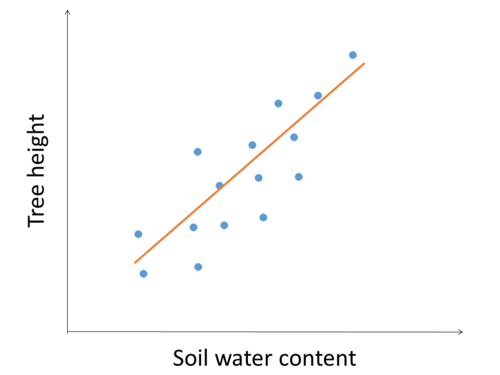
Ecologists use a variety of modelling techniques depending on the question they are trying to answer, and the amount and type of information available. Field ecologists most often want to understand the relationships between variables they have measured in the field. For instance, to understand whether trees grow taller in wetter or drier soils, they would measure tree height over a range of soil moisture conditions and use statistical models to relate tree height with soil water content.
Figure 1. An example of a model depicting the relationship between tree height and soil water content.
Theoretical ecologists, on the other hand often rely on purely mathematical concepts to formulate their models. Instead of going to the field and measuring tree height and soil water content, theoretical ecologists would use mathematical equations that reflect their knowledge about how trees grow taller in wetter areas. They might then compare their model’s predictions against measurements of actual trees, but many theoretical models are never actually confronted with “reality.”
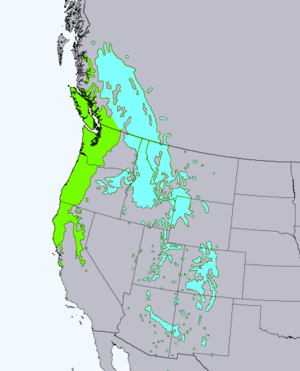
Then there are ecological modellers, like us in theLandscapes in Motion modelling team, who are somewhere in between. In complex projects such as ours we need a bit of everything. For example, to model the growth of an individual Douglas-fir tree, we can use a mathematical model relating tree size and tree age. But to modelwhereDouglas-fir trees can grow, we would use statistical models relating climate conditions with the tree’s real-life range. As you can see from Figure 2, Douglas-fir is unlikely to germinate in tropical or arctic climates!
We are neither relying solely on data, nor using theoretical models alone. We combine both (which is why we’re awesome!).
Figure 2. The current geographical range of Douglas-fir, divided into its two varieties: the coast Douglas-fir in green (also known as the Oregon pine, or Douglas spruce) and the Rocky Mountain Douglas-fir in blue. Image by the U.S. Geological Survey.
Modelling as part ofLandscapes in Motion
Our work is still in its early phases, but in general our objective is to understand how fire, vegetation, climate and topography interact to produce fires of different sizes, frequencies, and severities in the Foothills of Southern Alberta. Our model will need to reproduce the processes governing forest growth and fire spread, which will affect each other, and in turn how these are affected by climate and topography. We also want our model to be reproducible, easily updatable and transparent, which is why we are developing it usingSpaDESa modelling framework that makes all of these easily achievable.
How these processes may be simulated inSpaDESdeserves in itself a whole new blog post! So stay tuned if you want to accompany us in our modelling adventure!
If you want to find out more aboutSpaDES check these out:
“All models are wrong, some are useful” is a very famous (and correct!) phrase from a famous statistician, George Box, and probably the first thing aspiring modellers/statisticians learn about modelling!↩︎