I have recently written a blog post about myself for the Landscapes in Motion blog (here’s the link) which I am also sharing here. If you haven’t already, check the Landscapes in Motion website - and keep an eye on it for blog posts from other team members and project news!
This piece was originally published on the Landscapes in Motion blog. Landscapes in Motion is a large-scale, multidisciplinary project examining historical wildfire patterns and landscape change in the southern Rockies of Alberta, Canada. You can learn more about the project at Landscapes In Motion.
I’ve always been quite stubborn—although I prefer to consider myself as “someone who knows what they want”—and I knew from a young age that I wanted to work towards the protection of Nature. Unfortunately, I can’t say this came from growing up surrounded by impressive nature, or in a very natural setting. In fact, my childhood was mostly spent in an urban environment, close to Lisbon, Portugal. So I blame my Father for having exposed me to the National Geographic TV series and magazines as far back as I can remember, for repeating to me every day that even saving just one toilet paper leaf would help forests, for telling me water is as precious as gold. It is he who taught me to love and respect all things natural.
(I did, however, always have the sea present in my daily life, and at the age of 10 I got so angry about ocean pollution that I wrote a petition to the EU to “stop pollution and killing nature”—needless to say that getting signatures from my schoolmates didn’t really improve my popularity…!)
So choosing a degree was easy. It had to be Biology, although I ended up specialising in Terrestrial Ecology rather than “marine stuff”. Questions about my future arose after I graduated from the University of Lisbon. How did I want to help the world? Through research, consulting, or by getting involved with environmental policy? Fortunately for me, it wasn’t long before it became clear to me that my calling was research.
During my year as an MSc student at the University of Aberdeen, Scotland, I fell in love with the study of ecosystem resilience and stability. It fascinated me how ecosystems can cope with changes in fire regimes, climate, and human land-use. To a certain degree, all ecosystems are able to re-organize themselves and “absorb” these and other disturbances; however, they can only be “pushed” to a certain limit, beyond which they collapse and change to another type of ecosystem. How far can we push ecosystems, which ecosystems are more fragile, which are more resilient, are certain types of disturbances worse than others? These are the sort of questions that get me excited and motivate my work.
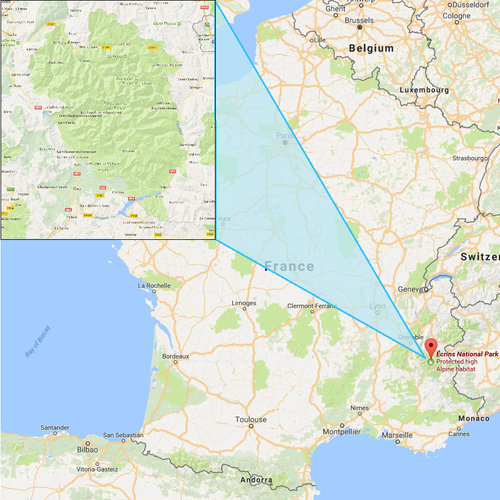
So, I decided to embark on a PhD journey where I could pursue my curiosity. This journey took me to Grenoble, in the French Alps, where I became interested in exploring whether different types of ecosystems were more sensitive to disturbances, and if different types of disturbances had greater consequences for the stability of these ecosystems. So I went big, testing these questions at the scale of landscapes and using computer models as my guinea pigs. I studied how climate change, changes in drought regimes and changes in rural activities interact and affect the vegetation in mountain ecosystems of the French Alps – more precisely in Écrins National Park. My modelling experiments have shown that the way humans use these ecosystems can have a very strong effect on many plant communities. Yet, warmer temperatures will also drive important long-term changes in these systems, with forests climbing in elevation and alpine plants receding. The effects of drought were at shorter time scales but quite drastic when drought was very severe and frequent.
Écrins National Park (Parc National des Écrins) is in southeast France in the Alps ([Google Maps](https://maps.google.fr))
An important lesson to take from this work is that disturbances affect ecosystems at different time scales. A severe fire, for example, can cause immediate changes in a forest by killing younger trees and burning ground-level vegetation. These changes can be measured year by year as ground-level vegetation recovers, and also over decades and centuries, as the fire will have affected the age distribution of the forest’s trees. It is important that we recognise this and remember that a forest’s lifetime is much longer than a human’s. Understanding how fire regimes have shaped forests and how they might change with climate warming requires looking relatively far into the past and into the future—which is why we need models.
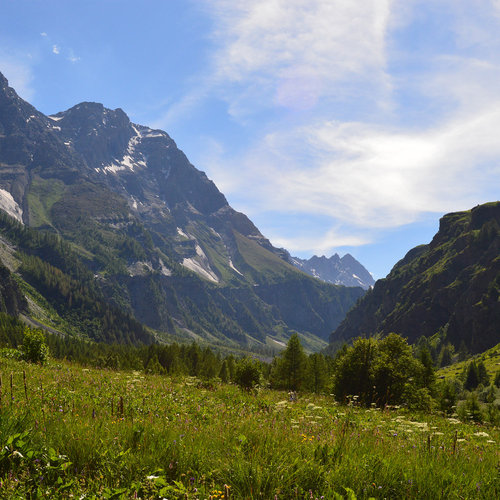
Mountain ecosystems of the French Alps in Écrins National Park. Photo by Ceres Barros
My passion for ecosystems, their resilience, and the lessons we can learn from them using computer models has brought me to the University of British Columbia, where I recently began a post-doctoral fellowship. As a member of the Landscapes in Motion team, I will develop models to reconstruct fire-driven dynamics in the forests of the Alberta foothills and predict how they might change in the future. Have past fires been very frequent and of low severity? Or infrequent and very severe? Or a mix of the two? What affected fire frequency and severity the most? Weather? The variety of tree species in the forest? Both? And what will happen if these change, will fires become more severe/frequent? And how will the forests change?
A lot has changed in the last year: I’m now living on a different continent, studying a different mountain ecosystem, and beginning the next stage of my career as a researcher. But some things never change—I’m still as stubborn as ever, which will serve me well as I strive to discover how ecosystems have been shaped and how they may change in the future.